
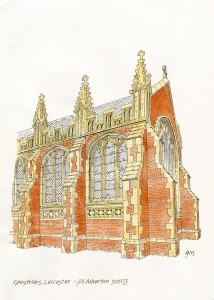
 Two days after unveiling a reconstruction of the face of Richard III, Leicester experts have now recreated how Greyfriars, his final resting place, might have looked.
Built in 1230, Greyfriars was one of the first Franciscan friaries to be established in England, just 6 years after the order came to Britain, but it was completely demolished during the 16th century Dissolution of the Monasteries.
 Now artist and archaeological illustrator Jill Atherton has recreated the friary church, as well as the choir where Richard’s grave was located, in sketches based on similar Medieval buildings, together with archaeological evidence from the recent excavation , including window fragments and pieces of lead, suggesting stained glass, together with stonework, pieces of a large window frame, and roof and floor tiles.

Click here to read more about how the church was discovered, or here to read our full report on how Richard III’s remains were identified, and what they tell us about his life and death.
I do hope the authorities realize that he was a Catholic king and that his enterrment and services should be Catholic and not Anglican.
You are correct but it is the living that decide what is to be done with the dead and in this case at least at the time of his death he was on singularly bad terms with the living. I wouldn’t count on him getting a church service now either.
Rubbish! Of course he will get a religious church service. it may be more than Richard deserved but it was his right and remains his right, even as a load of bones. Whether or not he gets a Catholic service depends on the authorities at Leicester Cathedral. I think that some of the requium will be Catholic, but I would not obkect to Anglican prayers and a united service. As long as the actual commitment is from the pre 16th century Mass; which means pre Vatican II and pre service book; then there is nothing wrong with prayers and readings from people from other parts of the Christian faith. To deny him a Christian burial is acting like a child; having a fit because they cannot get their own way at bed time. Richard was a Catholic King and he was a pius King: it is not important that he was not on terms with the living; that is not a judgement anyone is qualified to know or decide; what is important is that he most likely died in a state of grace; and that the living pray for his soul and God to receive him in mercy. After all we will all face the same Eternal Judge that Richard did and we would all want our mortal remains treated with respect to our wishes or our beliefs. We should do no less for his.
Indeed he was a member of the Catholic Church in England, with it’s distinctive English rites.
The Anglican Church has always claimed to be that same church, catholic, apostolic, reformed, but unbroken in lineage. Acceptance and agreement is not compulsory.
What is clear is that York is the most appropriate burial site for the King, other than perhaps Westminster Abbey, and that that service should be appropriate and focussed on Richard himself; and should be the Latin Sarum or York rites which remain valid expressions of Christian faith today.
The current Anglican liturgy would be as inappropriate as the current Novus Ordo Roman Catholic Mass. Least appropriate of all would be a ‘ecumenical’ service.. a kind of religious smorgasbord with the laudable aim of being inclusive but succeeding in being nothing much.
With respect, I don’t think that’s relevant now. He was buried in 1485 presumably with the monks saying [albeit hastily] the Catholic prayers of the day over his remains. His reinterrment should not be subjected to sectarian debate about whether it be in a Catholic or an Anglican cathedral. His forebears and those monarchs who came after him before the Reformation are now, after all, resting in places administered by mostly Anglican or Protestant affiliations. So long as RIII is reburied with the appropriate dignity and solemnity due to an annointed king, that’s all most of us Ricardians will care about.
who really cares ? its the same god
How dare you insult our Catholic rites by claiming it is all the same! No! It is not all the same! The Catholic Church is the true Church and Richard III was a Roman Catholic! While Anglicans are invited to take part; it is only showing him the correct respect to bury him with full Catholic honours and services. If this was 1485 and he was being buried for the first time this issue would not even exist! He should be given the same consideration now that he should have had wnen he was buried to begin with. He was denied that then, and now selfish heathen Anglicans want to deny him his rights yet again.