
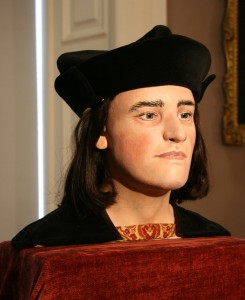
 More than 500 years after his death, members of the public can look King Richard III in the eye once more, following the unveiling of a reconstruction of how he may have looked.
Based on human remains found beneath a carpark in Leicester city centre by University of Leicester Archaeological Services, and recently identified as those of England’s last Medieval monarch, the model was created by Caroline Wilkinson, Professor of craniofacial identification at the University of Dundee and unveiled yesterday (5 Feb) at the Society of Antiquaries in London.
Beginning with a 3D scan of the king’s skull, layers of muscle and skin were built up digitally on a computer. The result was then used to create a plastic model, which was painted and dressed in period-appropriate clothing.
 ‘His facial structure was produced using a scientific approach, based on anatomical assessment and interpretation, and a 3D replication process known as stereolithography,’ said Professor Wilkinson. ‘The final head was painted and textured with glass eyes and a wig, using the portraits as reference, to create a realistic and regal appearance.’
She added: ‘It was a great privilege for us all in the Dundee team to work on this important investigation. It has been enormously exciting to rebuild and visualise the face that could be Richard III, and this depiction may allow us to see the King in a different light.’
The model was commissioned and funded by the Richard III Society, who were closely involved with the excavation during which the king’s remains were found.

‘It’s an interesting face, younger and fuller than we have been used to seeing, less careworn, and with the hint of a smile,’ said Dr Phil Stone, chairman of the Richard III Society. ‘When I first saw it, I thought there is enough of the portraits about it for it to be King Richard but not enough to suggest they have been copied.’
The facial reconstruction will eventually be loaned to Leicester City Council to be displayed in their planned visitors centre adjacent to the Greyfriars site, which will be dedicated to telling the story of King Richard III’s life and death.
Read our full report on how Richard III’s remains were found and identified here.
The bust certainly shows his heritage in the jawline. A rather handsome man overall.
I am one of those who follow the logic that having proven that his two nephews were illegitimate, Richard would have had no need to dispose of them, whereas his successor would have had a weaker claim to the throne than the princes through matrilinear lines, and that they constituted a graver threat to him than they ever did to Richard.
The reason that he killed them is because of fear that the public would take pity on the small boys of a beloved king and usurp his position. He had them killed. Things like this were done in those times. I think it is sad, but at the time for his survival, they were necessary.
Faction was not far from the surface at this period.Richard soon silenced the Wydeville opposition and we must assume Hastings too probably because of his loyalty to Edward IV and his heir(s.) Any alternative claimant might be a dangerous and destabilising factor. Not everyone would accept the princes’ illegitimate status.Was there any incontrovertible evidence Edward IV had married Eleanor Talbot ( Boteler anyway?If the boys were dead there was one less rallying point: one less immediate threat to Richard’s regime..Was there not an abortive attempt to spring them from the Tower of London?Why did Buckingham rebel? If the boys were still alive and no threat i..e illegitimate or disbarred from inheriting, why did n’t Richard show them to the London populace as Henry VII did Edward, Earl of Warwick when threatened by a likely imposter?
Richard was not the only one who could have killed the boys & frankly,I don’t see why he would have,being aware of the harm it would do him.If he did do so,then he must have been one of the greatest actors of all time because his loyalty to Edward his brother was unswerving.Buckingham,unstable & vain,could have killed the boys(if they were killed)Stanley & his wife are strong contenders & also Henry himself.
I had a dream where I was standing with a group of people when a strange man dressed in medieval costume with long dangling sleeves and silly pointed shoes, strode up to us. Addressing us as a man named Richard who was formerly a king of England but no more, telling us how annoyed he was to have his bones disturbed in such a disrespectful manner, and having his privacy intruded upon allowing all the world to inspect his mortal remains. Wagging a slender finger at us he also expressed his rage at having his remains entombed in Leicester Cathedral. He demanded Westminster Abbey alone so that his remains can lie in peace alongside his royal ancestors.
The man I saw in this dream bore little resemblance to the recent reconstruction. The hair is too dark for example. His eyes were blue/grey, and his hair was dark blond, and the nose was longer. He also had a dimple in his chin, reminding me of the actor Kirk Douglas in his prime. He struck me as quite a ruthless man capable of anything necessary to achieve his aims.
The reader might find my above comments laughable in the extreme, but this was a very real experience for me because I meet several people in a dream state I have formally known in life who are no longer on this earth.
Interesting dream.All the info I have had is that Richard was the small dark haired one in a family of blondes.Most of the Plantagenets were fair.I suppose,as a man of his times,Richard would have been ruthless when necessary,but I still don’t believe he killed his nephews. And he was a good king who worked hard to help his people.In the North,he was dearly loved&much mourned. I do feel he should have gone back to the north,as opposed to Leic.but yes,Westminster Abbey makes sense.
Dear Charles Edward: did he also tell you what happened to the Princes in the Tower? I think i trust the experts rather than someone who has a weird dream. Too much cheese!
Maybe it was Richard I or II!
Richard’s portrait was later altered the way you describe because Richard was revealed by genetic tests to be a dark blonde/very light brown with blue eyes. So I am inclined to believe you. Whaz else did Richard say in the dream of yours?
Privilaged to have seen the face on its recent tour; on 15th July at Bosworth Battlefield Heritage Centre were it was for a few days. I think my phone camera went into overdrive as ended up with 18 photoes from all sorts of angles. We were lucky as we only found out the day before that it was at Bosworth and not at Leicester centre; which we went to the following week. The video with the stages was very interesting and the close up of the head realistic. It was just like looking directly into the face of the living King. The university have to be commended for their accurate work and for bringing the King Richard back to life. I do not go with the soppy Ricardians who think he looks like a nice young man as you cannot tell what someone is like from their looks. He actually looks quite serious and has a sadness in his eyes; but that again is me seeing what I want in the face. Without looking into the eyes of the real Richard you cannot tell anything about his nature or his soul or his mood. Having said that it is very interesting that Richard is dark haired; most of the rest of the family were to some extent fair; but not all. Elizabeth’s Woodwille’s children were mostly blonde, but no, all of the Plantagenets were not blonde! George, Duke of Clarence was not blonde; and Henry VI was not blonde. Both men were Plantagenets. Richard I and KIng John were not blonde. You are thinking of the direct family of Richard or York and the children of Edward IV and Elizabeth, who were mostly blonde as the Rivers and Greys were blonde. I am afraid you have been watching too much Philippa Gregory!
Just as with the family of Richard III and his brothers or his sisters; the children of Henry Tudor and Elizabeth of York has mixed features. For example the Tudor redhair overcame the blonde Plantagenet, but Mary Rose Tudor was more fair than her elder brother. Genetics dictates that a darker haired child will appear in every six children; and a fairer one in every four or five. The same if you have parents with mixed brown and blue eyes. The lighter colour will only appear in the fifth or sixth child.
Again, congratulations to the facial construction people for the way they have brought the features back to life and how much like his portrait the face looks. It goes to show that the artists at the time made an accurate portrayal of Richard when they painted him and that he was not painted as either a monster or to hide anything. Some of his skeleton features may have been altered to hide his raised shoulder or to show it; but we now know that Richard had a deformed spine. So why would his portrait have been altered? Well you could still want to exaggerate his spinal problems and show him as deformed which he may not actually have been. He may not actually have been in any pain from it either as he was a good athlete and a soldier. He was physically fit and he had a full suit of armour; although this could have been made to allow for a raised shoulder.
The face also compels you to look straight at Richard and you know that you are looking into the eyes of a man who had his own way in life. Ruthless or not, Richard was a man of his time and his ruthlessness was balanced and actually well aimed and thought out; it was not random. He also believed in chivilary and he showed this by not executing Margaret Beaufort his enemy who had encouraged Buckingham to rebel against him. He did not believe it was chivilary to execute a woman; and showed this both in her being spared and in the fact that he protected and later married Anne, his enemies daughter.
Richard’s brother Edward IV is often described as blonde but hanks of his hair exist–they are in fact brown and not even a particularly light brown. This is not from chemical changes which often turn ancient hair red; this is their actual colour…and is backed up by Edward’s portraits, none of which show him with light hair. At least one shows his eyes as hazel or brown. All Richard’s portraits show dark hair with a reddish hint, quite pale skin, and blue-grey eyes. A prominent chin was in his portraits (as on the recon) but without the ‘conventional’ cleft added in on the best known NPG one.