
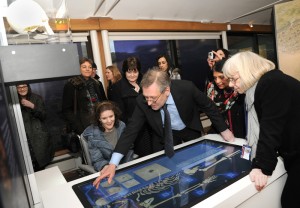
 A new free exhibition dedicated to the search for Richard III opened today (8 Feb) at Leicester’s Guildhall.
Richard III: Leicester’s search for a king reveals the archaeological detective work that led to the rediscovery of Greyfriars church, the location of Richard’s grave, and the identification of his remains.
Displays place these findings in their historical context, exploring what written sources tell us about the king’s life and death, and compare these to clues provided by analysis of his bones, from scoliosis to battle wounds.
 Interactive touchscreen panels allow visitors to examine these pathologies, while Loughborough University have also loaned a model of the monarch’s skull, created by 3D printing based on CT scans of the remains.
Finds from the Greyfriars excavation are also on display, including decorated floor tiles and masonry from the Medieval church, as well as an accurate model of the Blue Boar Inn, the building in Leicester where Richard spent the night before leaving for Bosworth.
The exhibition is free and it is expected to remain at the Guildhall until a permanent visitor centre is built.
Is all DNA evidence finally in to erase any and all doubts about the identity of these remains?
Yes, the mitochondrial DNA from 17th generation relative, Micheal Ibsen and also an anonymous second lineage both matched that of the Grey Friars skeleton – as if the rest of the evidence weren’t enough to confirm the identity anyway!
A descendant proven by genealogy not DNA. DNA only matches the skeletal remains to living individuals; one unidentified. The remains exhibit remarkably few injuries; several to skull and one to hip. So history is wrong stating how his remains were savaged in death. What was the rush to conclude this inquiry? And it was rushed. Until DNA from Richard the 3rd’s kin, sibling or one of their immediate decesdants, this looks more like one of our poorly done American reality tv than credible scientific and historical inquiry. Genealogy is not DNA.
Dear ranter: he was identified by DNA from a living relative; via his sister down the female line and then via two other lines to confirm. His skull clearly shows that he was savaged! He has a blow to the top of the head; he has a blow to his cheek that cut part of his face away and his teeth and face cut away down one side: this part of the skull was sliced right through. There is a third sword blow that had his brain hanging out, and another that was the death blow; deep and into the lateral line from the back of the head to the front and is quite deep. There is a blow in the top of his head and another one into his shoulder. At least 8 serious sword and other weapon cuts show that he was in a life and death struggle to fight off several people as he was killed. He then suffered three or four other cuts to the body that are post mortem. The final humiliation blow may not be that, but that is not clear. He may have also suffered several blows to the body; we do not know for certain. The sources do not state he was savaged to death, but that he received several blows as he was surrounded by soldiers. The blows on the skull and his bones show that he was struck a number of times and received horrible injuries.
Genealogy may not be DNA: but DNA is DNA! We cannot take from his immediate descendents as he did not have any! His only son died when he was ten years old; so we have to use the closest lines possible and this was done via his sister Anne and two other relatives. It was also taken back via living relatives from his siblings and also from a neice. The inquiry was not rushed and work is still going on. The bones were dug up in September 2012 and took until February 2013 to do the initial research. Science allows for things to be done reasonably fast. Everything was done with care and I am certain that the experts at Leicester and other experts brought in know what they are doing. I do not know what your qualifications are but ranting is not the way to get a sensible point over or to debate the question.