Burial chambers of the Neolithic In the Neolithic – the New Stone Age – the older you were, the more important you were, and thus logically the dead were the most important of all. Ancestor worship became the centre of people’s lives, and great emphasis was placed on the burial of the dead.
1300 BC – The Dover Bronze Age Boat
A large Bronze Age boat has recently been discovered at Dover. Keith Parfitt, of the Canterbury Archaeological Trust, reports.
200 BC – Castell Henllys
The Celts were warriors, and the most prominent remains of the Iron Age are the great hillforts, surrounded by banks and ditches – sometimes several banks and ditches one outside the other.
100 BC – The Snettisham Treasure
The great Iron Age hoards discovered at Snettisham in Norfolk form the richest Iron Age treasure ever discovered in this country.
AD 43 – Colchester, Roman Camulodunum
A rich burial dating to within 20 years after the Roman conquest has just been excavated in a gravel quarry at Stanway, just outside Colchester.
AD 50 – The story of Roman London
Most Roman towns were sited either over previous towns, or over Roman forts. London was unusual in that it appears to have been founded from scratch. And it wasn’t a quick foundation. The Roman invasion was in AD 43, but it was not until around AD 50 that the first coins indicate the foundation of [...]
AD 105 – Vindolanda
Roman documents discovered Probably the most important – and certainly the most dramatic discoveries made in Roman Britain in the 20th century have been the wooden writing tablets discovered at Vindolanda.
AD 200 – Littlehay Roman Barn
Roman Britain does not just consist of grand buildings. There are also smaller buildings out in the countryside, and at Littlehay, near Derby, the local society excavated one such barn on their own initiative – reminding us that local societes can still make a major contribution to archaeology.
AD 200 – Valtos: brochs and wheelhouses
While the Romans were civilising England, life was very different story in Northern Scotland, and particularly in the outer isles, Orkney and the Hebrides.
AD 300 – Roman Mosaics
Roman mosaics are perhaps the most spectacular Roman remains in Britain. Many of the finest come from Roman villas, where they reflect the high artistic tastes of the wealthy villa owners in the fourth century. Most are in colour, and many are figured, almost always with classical scenes.
AD 350 – Arbeia Roman fort at South Shields
In the early 4th century, a troop of boatmen were transferred from one end of the Roman Empire to the other. Abandoning the warmth of the River Tigris, they found themselves enjoying the delights of South Shields, a supply fort at the eastern end of Hadrian’s Wall.
AD 500 – Tintagel
Has King Arthur been discovered at Tintagel? Tintagel, on the North coast of Cornwall, is famed in legend as the home of King Mark (of Tristan and Isolde fame) and the possible place where King Arthur was conceived.
AD 700 – Sutton Hoo
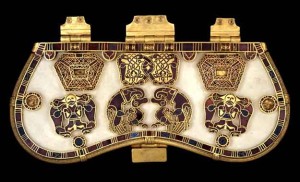
In the 7th century AD, a King – it was surely no less – received a magnificent burial at Sutton Hoo, in East Anglia. A ship was hauled up from the river, a burial chamber was erected in the middle of it, and a stupendous collection of magnificent objects – gold and silver brooches and [...]
AD 700 – Saxon London Discovered
What happened to London after the end of Roman rule? Bede calls it a ‘mart of many nations’ yet for long the archaeologists could find no trace of this early Saxon London. Then, suddenly, they found it. Not where they expected it, in the ruins of Roman London, but on an entirely new site a [...]
AD 800 – Vikings invade the Udal
Perhaps the biggest disruption in the Hebrides was the advent of the Vikings. But what remained of them and what trace did they leave in the archaeological record? The most remarkable discovery was what appeared to be a Viking fort.
AD 886 – Return to the Roman City: Bullwharf
On Christmas Day 886, King Alfred, exasperated by the attacks of the Danes, finally decided to abandon the undefended ‘open’ site of Lundenwic, and to return to the safety of the old Roman walls. At Bullwharf, evidence of this very first return has been discovered, on a site already recorded in the documents as ‘Queenhythe’. [...]
AD 900 – The Origins of the English Village
When did the typical English village begin? That is, when did the outlying farms join together to become a nucleated village? Professor Mick Aston has been finding out.
AD 1000 – Canterbury Cathedral
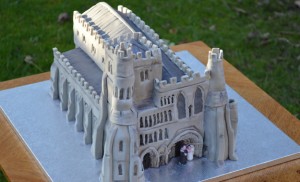
A major Anglo-Saxon cathedral has been revealed – directly under the flagstones of the nave of Canterbury Cathedral. To everyone’s surprise, the Anglo-Saxon Cathedral was almost as big as its Norman successor.
AD 1200 – Norwich: the second largest medieval city
Norwich was the second largest city in Medieval Britain: why? In recent years a number of major sites covering more than 20 acres in all have been excavated in medieval Norwich, which between them have revolutionised our knowledge of this crucial medieval city. Let us take a look at these excavations in order to throw [...]
AD 1250 – Wood Hall
In the Middle Ages, life was communal, and the basic building structure was the open hall. Even comparatively grand structures, such as manor houses, consisted mainly of a large open hall with a fire at the centre, where the smoke escaped up to the rafters and through the thatched roof. A good example of such [...]