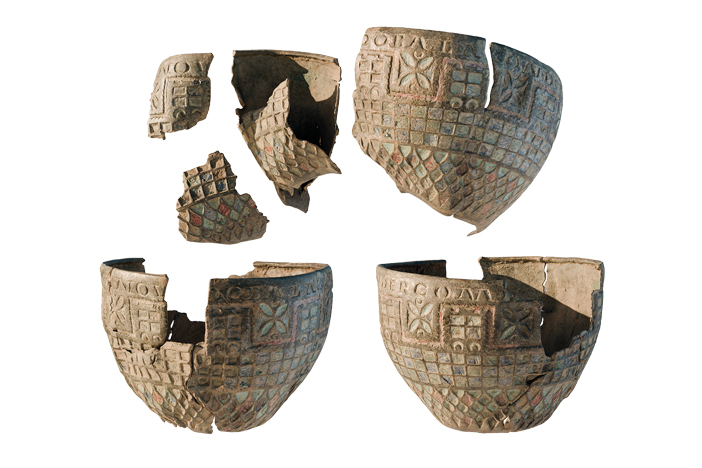
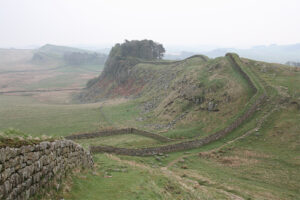
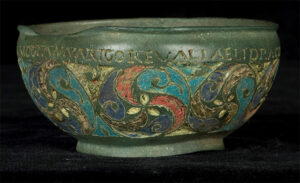
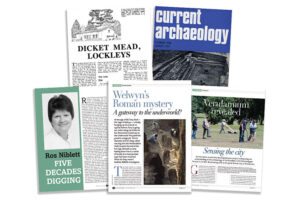
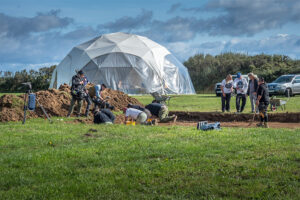
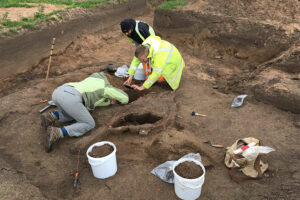
Robin Birley set out to excavate the entirety of the Vindolanda fort and associated civilian settlement on Hadrian’s Wall in 1970, calculating that the task would take him 20 years. Some 36 years on, he now thinks the task will take at least another 100 years of dedicated work.
England’s First Castle
While planning a book on the castles of Herefordshire, Terry Wardle came across references in the Anglo-Saxon Chronicle to a castle built in 1051 by a Norman named Osbern.
Caldecote: The Development And Desertion Of A Hertfordshire Village
The manor house, six labourer’s cottages and a church are all that now survive above ground of one of Hertfordshire’s smallest parishes, but plenty of earthworks survived to hint at a much larger Medieval settlement until 1973, when ploughing began to erode the site rapidly and a five year rescue excavation was set in train.
English Heritage Historical Review Volume 3
Parts of English Heritage could be likened to a private university in that some lucky members of staff (and their advisors and consultants) get to do the kind of primary research that even university academics struggle to find time for these days. Much of this research is used to inform the preservation and presentation of [...]
Archaeology: What It Is, Where It Is And How To Do It
Paul Wilkinson’s beginner’s guide to practical archaeology comes with a solid endorsement from Mick Aston (‘I wish this book had been available when I started in archaeology’), and is selling very well, which reflects the demand that there is for a good primer, even in this era of constraint on volunteer archaeology.
Warlords: The Struggle For Power In Post-Roman Britain
Whoever coined the term ‘the Dark Ages’ must have been an archaeologist, because the literary record for the post-Roman period is far from sparse. Stuart Laycock (author of Britannia: the failed state, nominated for the Current Archaeology Book of the Year Award 2009) is one of a growing number of archaeologists who have begun to [...]
The Oxford Handbook Of Archaeology
The editors state in their introduction that ‘we have encouraged the contributors [to this book] to develop their own points of view … to show the plurality of archaeology … [and to give] … some sense of the excitement, possibility and controversy of archaeological practices and results’. They have succeeded superbly, and though this Oxford [...]
Landscapes Of Memory
This collection of essays reprinted from Merry Meet magazine (‘an independent quarterly journal of folklore and paganism’) begins with a disarming introduction in which the author, answering the charge that modern Paganism is a made-up religion, pleads guilty. But, he says, the modern Pagan revival is rooted in the findings of archaeologists and folklorists, and [...]
Prehistoric And Roman Essex
The author of this guide to the prehistoric and Roman sites in the boulder-clay lands of Essex and south Suffolk wants us to go out and look at the landscape and develop a feel for the archaeological dimension, to which too many people are blind. From a train window, do you see grass and trees, [...]
A ‘Splendid Idiosyncrasy’: Prehistory At Cambridge 1915–50
Pamela Jane Smith’s book is about the rise of prehistoric archaeology as an academic discipline and the inception of the world’s first formal honours degree course in archaeology, which occurred at Cambridge in 1915.
Roman Mosaics of Britain: the view from the South East
David Neal and Stephen Cosh have reached the South East England stage in their marathon undertaking to publish every known Romano-British mosaic. Chris Catling reports on what, in mosaic terms, sets this region apart.
The ‘champion’s portion’? prehistoric feasting at Llanmaes
An important feasting site is being excavated at Llanmaes in south Wales. Along with fabulous metalwork and pottery, archaeologists have found a very mysterious array of bones in the midden site. What could it mean?
Who killed Lindow Man?
In the summer of 1984, archaeologists recovered the well-preserved remains of a 2,000-year-old body from a bog in Cheshire. Years later, the file is still open on this ancient whodunnit. Features Editor Neil Faulkner asks: is the traditional interpretation of ritual killing correct?It was on 1 August 1984 that a worker at a peat-cutting company [...]
The Old Dock: How Liverpool grew to greatness
In 1700, Liverpool was a small town with a dock that was in danger of silting up. Yet it was a town with prospects: Chester, which had hitherto been the main port in the north-west, was silting up even more. The discovery of the Americas had increased the importance of ports facing the Atlantic, [...]
Kenilworth Castle: the wooing of a Virgin Queen
English Heritage has just spent £2.1 million recreating an Elizabethan garden based on an eyewitness description published in a letter in 1575. But was the letter a spoof made up by rivals for the Queen’s favour, and what part did archaeology play in pinning down the truth? Chris Catling investigates.
"It’s a long, long way to Tipperary…”: the archaeology of the Great War at Otterburn
High on the moor at Silloans, within the Otterburn Training Area, lies the well-preserved remains of a trench system.
From barrow to bunker: Archaeology on the Otterburn Training Area
To get to the bottom of why, and how, the Ministry of Defence looks after archaeology on an active firing range, CA Editor Lisa Westcott spent some time with the people on the front line.
Blood, stones and genes: the new science of human evolution
A new BBC documentary presented by Alice Roberts has been charting the spread of modern humans across the globe. Is it really true that we are all Africans? Current Archaeology assesses the latest evidence.
Forteviot
A 9th century palace, an enormous 3,000-year-old Neolithic earthworks and the origins of Scottish kingship: Gordon Noble and colleagues from the University of Glasgow investigate.Few visitors notice the plaque in the village of Forteviot, Perthshire, Scotland, that records the death of Kenneth Mac Alpin, a 9th century king of Scotland. It refers to a passage [...]
Buried face down: Prone Burials
Archaeologists have excavated over 600 bodies from around the world, mysteriously buried face-down. Britain is the biggest hotspot – with more than 200 prone burials. What do they signify? Caroline Arcini of Sweden’s National Heritage Board has been investigating.