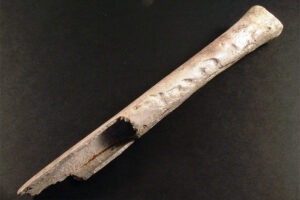
A very rare mammoth carving has been discovered on a wall in Cheddar Caves (Somerset, England). The 13,000 yearold carving is being hailed as one of the most significant examples of prehistoric art ever found in Britain.
Orkney's new Skara Brae
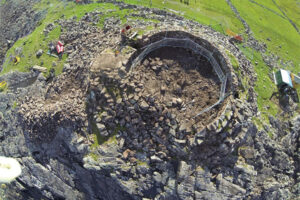
A Neolithic complex has been found in Orkney (Scotland) that rivals the importance of the well-known Skara Brae site. Only a small part of the 4-5,000 year-old, 2.5 hectare site has so far been unearthed, including large, well preserved stone buildings, (some believed to be ritualistic in nature) and other structures which are likely to [...]
Leave the stones alone!
Northumberland National Park archaeologists, rangers and volunteers from Coquetdale Community Archaeology Group are taking part in a major conservation effort to restore the ancient monuments of the Simonside Hills which have been damaged by enthusiastic walkers.
Rotherwas Ribbon unwound
Archaeologists in Herefordshire have uncovered a hitherto unknown type of monument – a serpentine path at least 75m in length, made up of fire-cracked pebbles – on a sloping hillside between the ridge at Dinedor, with its Iron Age fort, and the River Wye at Rotherwas, two miles southeast of the city of Hereford.
Mick Aston reveals the secrets of Time Team
The Time team is Britain’s longest running archaeology TV series. Here, Professor Mick Aston, the leader of the Time Team, reveals the secrets behind the programme’s success.
Medieval Art of Death and Resurrection
‘Flames were in their eyes, and in their teeth whiteness, and in their whole body a noisome blackness appeared…’
How to Kill a Witch – The Reigate witch bottle
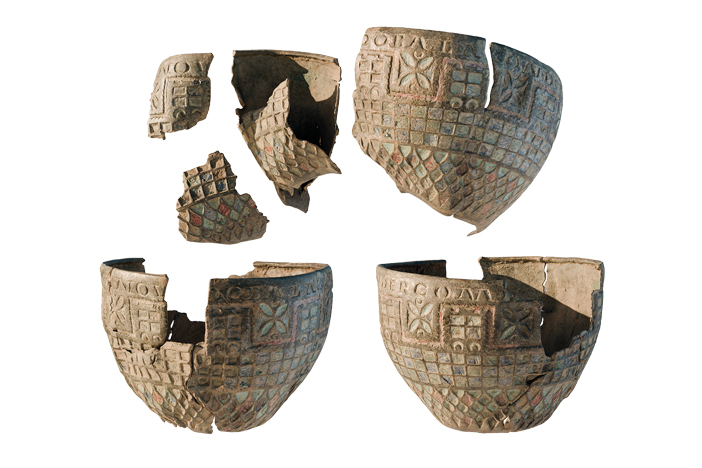
What do you do if you find yourself bewitched? If you find you are constantly out of sorts, and you just know someone has put the evil eye on you? The answer is obvious: you must set about killing the witch who has bewitched you. But how do you set about killing a witch?
Footloose in Archaeology
“Feet- did you say Feet?-Ugh-h-h!” That is the usual remark I hear when I mention my Research Project. I hope that when you have finished reading this your reaction will have changed.
Map of the Digs
{mosmap kml='http://tech.reumer.net/images/example.kml'}
Advice and encouragement for first-time diggers
Many people from all walks of life find the idea of going on an archaeological dig to be a fascinating prospect, but face the reality of actually doing it with a certain amount of trepidation. Fear not – most excavations looking for volunteers and/or trainees anticipate all levels of experience and are set up (with [...]
Joining a field school
Few activities are as rewarding as the physical exploration of a personal hobby or interest, and for archaeological enthusiasts an increasing variety of opportunities to participate in fieldwork are becoming available across the country. There is high demand each season for places on the expanding number of training excavations and field schools, as people from [...]
Carenza's first dig
Carenza Lewis, Preceptor in Archaeology at Corpus Christi College, Cambridge, and Team member of Channel 4’s Time Team tells us of going on her first dig
Welcome to Current Archaeology!
The Current Archaeology website is going through a metamorphosis… It will be down from 27/9/2007, but it should be back up and running better than ever from 1/10/2007. For subscriptions, please call us on 08456 44 77 07 Rob Selkirk
I love the past! Do you?
I have spent all my life studying the past. From travelling around the UK in my camper van going from site to site in the summer, to visiting the archaeology of Guatemala, South East Asia, all across Europe and many other corners of the world. The best thing about the past is being part of [...]
The Archaeology of Hampton Court
On the night of 31 March 1986, Hampton Court Palace caught fire. The great state apartments, built by Wren, were ravaged, but a decision was at once made to restore them to their original condition. The Historic Royal Palaces Agency has decided also to restore King William Ill’s Privy Garden, which was laid out with [...]