The Archaeology of Leprosy and the Black Death

The Archaeology of Leprosy and the Black Death

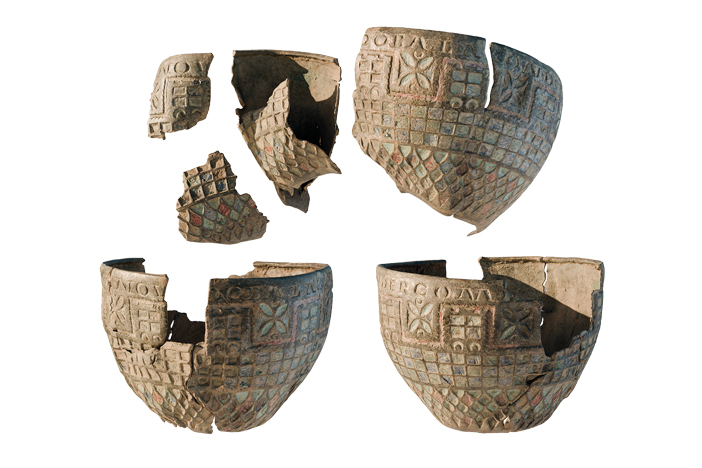
By contrast with those familiar institutions of the post-Norman era, the castle, the abbey and the church, Medieval hospitals have received little attention from archaeologists. That deficiency has now been remedied by the publication of Lepers Outside the Gate, edited by John Magilton, Frances Lee and Anthea Boylston, in which they report on excavations carried [...]

Trophies of Kings : The Staffordshire Hoard

Trophies of Kings : The Staffordshire Hoard

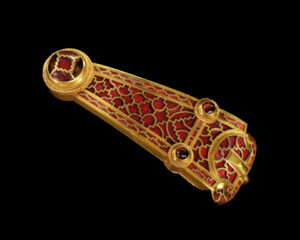
Britain’s biggest ever Anglo-Saxon hoard has been discovered, almost 70 years to the day since gold was first unearthed at Sutton Hoo. Is this electrifying new find evidence of trophy collecting by the kings of 7th century Mercia?

Staffordshire Hoard: trophies of warrior kings

Staffordshire Hoard: trophies of warrior kings

The largest hoard of Anglo Saxon gold ever found, was discovered this summer by a metal-detectorist in a field in Staffordshire and is set to revolutionise our perceptions of life in the 7th and 8th centuries. With more than 650 items made from gold and more than 500 in silver, this is truly a king’s [...]

Nick Saunders: launching the new discipline of modern conflict archaeology

Nick Saunders: launching the new discipline of modern conflict archaeology

First World War trenches? Second World War air-raid shelters? Cold War bunkers? This is the stuff of modern conflict archaeology, but what can it teach us that we don’t already know about such thoroughly documented events as the great military confrontations of the 20th century? Bristol University is about to launch the first-ever degree course [...]

Achill Island: Irish island archaeology from the Neolithic to the Great Famine

Achill Island: Irish island archaeology from the Neolithic to the Great Famine

The recent work of the Achill Archaeological Field School examines the island’s archaeology from the Neolithic through to the dark days of the Great Famine. Stuart Rathbone explains. Achill Island is a remote spot on the north west coast of Ireland, separated from the mainland by a narrow sound. It is the largest of the [...]

Norfolk: land of Boudicca

Norfolk: land of Boudicca

Leading Norfolk archaeologist John Davies has just published a new book on the perennial favourite rebel queen, Boudica. We asked him to explain what recent archaeological discoveries have revealed about the homeland of the Roman Empire’s most famous British enemy.

Worship, Death and Taxes: the story of Higham Ferrers

Worship, Death and Taxes: the story of Higham Ferrers

Two very important discoveries have been made at the multi-period site of Higham Ferrers, in Northamptonshire: one a Romano-British shrine complex, and the other an example of the realities – and occasional brutalities – of Middle Saxon regional government. Oxford Archaeology’s Alan Hardy takes up the story. Higham Ferrers lies in what is now an [...]

Greening the valleys:

Greening the valleys:

the archaeology of industrial Wales Wales was central to the world’s first industrial revolution; the abandoned remains of 200-year-old coal and iron industries litter the valleys. Frank Olding reports on the Green Mines Project, which is conserving and presenting the physical remains in Blaenau Gwent and regenerating this once-plundered landscape. An 18th century ironworks; a wealthy ironmaster’s mansion; poignant [...]

Hill Hall: home of a Tudor intellectual

In 1969, fire raged through this exceptional Elizabethan house. Paul Drury explains what archaeologists were able to rescue from the burnt-out husk. Since 1952, Hill Hall, at Theydon Mount, in Essex,  had been a women’s open prison whose unwilling guests included Christine Keeler. To architectural historians, this was indeed a fall from grace for an [...]

Galloping down the centuries: new light on Britain's chalk-cut hill-figures

Galloping down the centuries: new light on Britain's chalk-cut hill-figures

With the widespread use of optical stimulated luminescence (OSL) for dating soil samples, the mysterious giant hillside carvings of horses and men are finally being placed in an historical context. Paul Newman, author of a comprehensive survey of the subject, considers our current knowledge of these impressive relics, set against the many ways we have [...]

Making a mint: the archaeology of a Late Iron Age industry

Making a mint: the archaeology of a Late Iron Age industry

There were no credit crunches in the Late Iron Age: highly skilled Celtic mintmasters took painstaking care to ensure money had real, solid, and unchanging value. Mark Landon has studied two huge hauls of coin-making debris from North Hertfordshire and reports on his findings.

Buckles, belts and borders

Buckles, belts and borders

How soldiers’ fashions reflect political turmoil in Late Roman Britain A Romano-British army in Spain. Anglo-Saxon mercenaries in eastern England. A great tribal confederation spanning south Britain. Stuart Laycock has been finding fresh evidence for the storm and strife at the end of Roman Britain in collections of buckles and belt-fittings.

Roman Mosaics of Britain: the view from the South East

Roman Mosaics of Britain: the view from the South East

David Neal and Stephen Cosh have reached the South East England stage in their marathon undertaking to publish every known Romano-British mosaic. Chris Catling reports on what, in mosaic terms, sets this region apart.

The ‘champion’s portion’? prehistoric feasting at Llanmaes

The ‘champion’s portion’? prehistoric feasting at Llanmaes

An important feasting site is being excavated at Llanmaes in south Wales.  Along with fabulous metalwork and pottery, archaeologists have found a very mysterious array of bones in the midden site. What could it mean?

Who killed Lindow Man?

Who killed Lindow Man?

In the summer of 1984, archaeologists recovered the well-preserved remains of a 2,000-year-old body from a bog in Cheshire. Years later, the file is still open on this ancient whodunnit.  Features Editor Neil Faulkner asks: is the traditional interpretation of ritual killing correct?It was on 1 August 1984 that a worker at a peat-cutting company [...]

The Old Dock: How Liverpool grew to greatness

The Old Dock: How Liverpool grew to greatness

  In 1700, Liverpool was a small town with a dock that was in danger of silting up. Yet it was a town with prospects: Chester, which had hitherto been the main port in the north-west, was silting up even more. The discovery of the Americas had increased the importance of ports facing the Atlantic, [...]

Kenilworth Castle: the wooing of a Virgin Queen

Kenilworth Castle: the wooing of a Virgin Queen

English Heritage has just spent £2.1 million recreating an Elizabethan garden based on an eyewitness description published in a letter in 1575. But was the letter a spoof made up by rivals for the Queen’s favour, and what part did archaeology play in pinning down the truth? Chris Catling investigates.

"It’s a long, long way to Tipperary…”: the archaeology of the Great War at Otterburn

"It’s a long, long way to Tipperary…”: the archaeology of the Great War at Otterburn

High on the moor at Silloans, within the Otterburn Training  Area, lies the well-preserved remains of a trench system.

From barrow to bunker: Archaeology on the Otterburn Training Area

From barrow to bunker: Archaeology on the Otterburn Training Area

To get to the bottom of why, and how, the Ministry of Defence looks after archaeology on an active firing range, CA Editor Lisa Westcott spent some time with the people on the front line.

Blood, stones and genes: the new science of human evolution

Blood, stones and genes: the new science of human evolution

A new BBC documentary presented by Alice Roberts has been charting the spread of modern humans across the globe. Is it really true that we are all Africans? Current Archaeology assesses the latest evidence.

jhjh