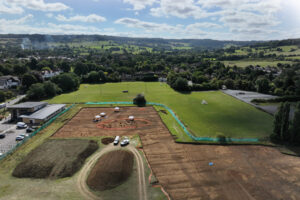
The Kilkenny Workhouse mass burials: an archaeology of the Irish Potato Famine
Sands of Time: Domestic Rituals at the Links of Noltland
Rapid erosion has revealed spectacular Neolithic and Bronze Age archaeology on the coast of Westray, Orkney. Contemporary with the Ness of Brodgar’s religious monuments but with a domestic focus, what can this settlement tell us about daily life in prehistoric Orkney? Hazel Moore and Graeme Wilson explained. Overlooking the North Atlantic on the island of [...]
Finding HMS Namur
In 1995 the discovery of part of a Royal Navy warship hidden in the Wheelwrights Shop at The Historic Dockyard, Chatham, sparked a hunt to determine both the name of the vessel and what it was doing there. Now, this unique find has proven to be the final twist in the tale of an exceptional [...]
10 things you might not know about the Mary Rose
Launched in 1511, the Mary Rose was intended to be the flagship of King Henry VIII’s fleet. She was a new breed of warship with purpose-built gun-ports that made her a fearsome floating fortress. But on 19 July 1545, for reasons still unknown, she sank in the Solent whilst leading 60 ships against the French. [...]
Richard III: the search for the last Plantagenet king
On 12th September the University of Leicester held an extraordinary press conference. They announced that a three week dig seeking the remains of Richard III had ‘entered a new phase’ with DNA testing under way on an adult male skeleton. So what had they discovered? Richard Buckley, Jo Appleby, and Helen Foxhall Forbes told Matthew [...]
Exclusive interview – Mick Aston: an archaeological journey
Real-life Archaeologists rarely become household names. Mick Aston is an exception. A defining voice in the development of Time Team and stalwart of the show since its first season in 1994, Mick’s resignation earlier this year ignited a media firestorm. He was in the news again in July after receiving a lifetime achievement award at [...]
Jupiter, best and greatest – Revisiting Maryport’s ritual pits
New excavations have revealed why the country’s finest set of Jupiter altars were committed to the earth in gigantic pits. Ian Haynes and Tony Wilmott explained the contents of the Maryport pits to Matthew Symonds. ‘Never before’, the great Hadrian’s Wall scholar John Collingwood Bruce declared in July 1870 ‘were the antiquaries of this district [...]
London’s volcanic winter
Is a Medieval mass grave in London’s Spitalfields cemetery linked to a massive volcanic eruption?
Reading the bones: Spitalfields’ human remains
Spitalfields in London is thought to be the largest excavated cemetery in the world. Recent research has focussed on the site’s mass graves, uncovering a wealth of new information about the population of Medieval London. One of the archaeological advantages of mass burials is that the urgency of the situation leaves no time to [...]
Do Irish Bog Oaks Date the Shang Dynasty?
In CA 111 Chris Scarre pointed out that the explosion of Thera could be dated to 1626 BC. This may, however, only be the beginning. There are at least 4 other prehistoric dates that the readers of CA should learn by heart; I believe that our work on tree-rings has revealed several major volcanic eruptions which may have caused climatic upset on a world wide basis. [...]
Volcanoes and population
In 1985 I presented a population graph for Britain extending from the Mesolithic to recent times, which was characterised by periodic ups and downs, the lows being the result of catastrophic processes in which an overall loss of the order of 50% in a century was envisaged. This was on the level of the historical population disasters of the 6th and 14th centuries AD. Just such [...]
Volcanoes, Catastrophe and the Global Crisis of the Late Second Millennium BC
When Andrew Selkirk asked me to append some comments to Mike Baillie’s piece on volcanic “events”, it prompted the notion that I had written on catastrophes in Current Archaeology some years ago. It proved after a long search to be exactly ten years ago (CA 67) and to be a paragraph entitled “Catastrophe?” I postulated then a [...]
Raising the Curtain: Excavating Shakespeare’s lost playhouse
Immortalised in Henry V as ‘this wooden O’, the Curtain Theatre in Shoreditch was home to Shakespeare’s company of players until the completion of the Globe in 1599. Yet despite staging some of the playwright’s most famous works, barely 50 years after its opening in 1577 the theatre faded into obscurity and was lost– until [...]
Oakington: Life and death in the East Anglian Fens
Anglo-Saxon skeletons have been surfacing for almost a century in the fields of Oakington. Now a new project has laid bare the trials and tragedies of a small 6th-century Fenland community. Duncan Sayer, Richard Mortimer and Faye Simpson bring flesh to the bones. In 1926 four early Anglo-Saxon burials, one equipped with a spear, knife [...]
Orkney’s first farmers
An entire Neolithic settlement, predating Skara Brae, has been found on the tiny Orkney Island of Wyre.
Treating leprosy
Were lepers reviled as ‘unclean’ outcasts of the Middle Ages? Recent excavations cast doubt on this enduring belief