Curator of Archaeology Natalie McCaul holding the deer headdress.

After the Ice: exhibiting life at Star Carr

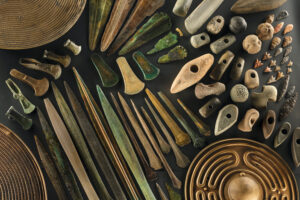
11,000-year-old artefacts from Star Carr, Britain’s largest-known Mesolithic settlement, will go on display for the first time tomorrow (24 May), with the opening of a new exhibition at the Yorkshire Museum. With highlights including deer skull head-dresses, bone harpoons, and amber and shale jewellery, preserved by the peaty environment of the lakeside camp where they were [...]

TNRExcavateLondonV1

Digging London’s past: Syon Park excavation

This summer the Museum of London will return to Syon Park, Hounslow, with digging opportunities for adult and children, it has been announced.   Having previously focussed on investigating the house of Sir Richard Wynne, a Parliamentarian on whose land the 1641 Battle of Brentford was fought as anti-Royalist forces tried to stop Prince Rupert’s troops reaching [...]

7_2_Dene_recreated

Peasant houses in Midland England: How the Black Death prompted a building boom

ca279_banner_280x165

Current Archaeology 279

What was life really like for Medieval peasants? Renowned as the epitome of poverty, they appear as stock images performing hard manual labour in the margins of illustrated manuscripts. With the squalor they faced memorably lampooned by Monty Python, among others, it has always been assumed that the ramshackle hovels they called home have long [...]

AC8_6349crop

VIDEO: The search for Richard III – Richard Buckley at CA Live! 2013

David Jacques with part of the pelvis of an Aurochs

Cradle of Stonehenge: interview with David Jacques

In CA 271 we brought you news of astonishing Mesolithic finds at Vespasian’s Camp on Salisbury Plain, a potentially game-changing site for our understanding of the Stonehenge landscape. With the site about to star in the first episode of a new BBC archaeology series, we caught up with project director, Buckingham University’s David Jacques, to find [...]

Image courtesy of the Portable Antiquities Scheme

Scale models: George and the dragon

Standing just 4cm high, St George raises his lance to strike a fatal blow against the tiny dragon staring back at him. His outstretched hand probably once gripped his scaly foe by the tail, though they have since broken apart. Discovered by a metal detectorist in the Carlisle area last April, these silver gilt figures [...]

IMG_3663

Vespasian’s Camp: Cradle of Stonehenge

Future archaeologists in the making

Roman in the snow: hundreds visit NW Cambridge Site open day

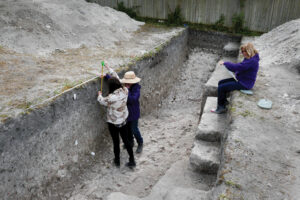
Almost 500 people braved the snow to visit the Northwest Cambridge Site’s extensive archaeological remains during an open day last month. A 14ha excavation by Cambridge Archaeological Unit has revealed Roman activity spanning four centuries, as well as archaeological features stretching back to the Middle Bronze Age (c.1500 BC), suggesting that the rolling green farmland northwest [...]

DSC_6382 mod

Cambridge’s Roman development

The rolling green farmland northwest of Cambridge was once crowded with bustling Roman settlements and industry, recent excavations suggest. Cambridge Archaeological Unit has investigated 14ha outside the city, revealing Roman activity spanning four centuries, as well as archaeological features stretching back to the Middle Bronze Age (c.1500 BC). Zig-zag ditches thought to represent practice trenches from [...]

Amber amulet in the shape of a gladiator’s helmet. Amber was an expensive imported material and was thought to have magical powers. The Roman author Pliny describes how amber amulets could protect children from illness and the symbolism of the gladiator may also be protective 
Image: MOLA

Murmillo magic

A tiny amber amulet shaped like a gladiator’s helmet has been discovered in the Walbrook area by Museum of London Archaeology (MOLA). Measuring just over 1cm across, the object was found amongst the remains of a demolished Roman building, together with large amounts of pottery and animal bone. It is hoped that analysis of these [...]

Mithraic masonry: MOLA's Ian Blair cleans the deeper south-aisle wall foundation at the temple's original location.

London’s roaming temple – new parts of the Mithraeum found

Britain’s most-moved Roman site, the Temple of Mithras in London, is one step closer to returning to its original location after recent work by Museum of London Archaeology (MOLA). Since it was uncovered in the 1950s the third-century temple has been completely dismantled, shifted 90m, rebuilt, taken apart again, and is currently in storage in [...]

Bloomberg

Revealing Roman London

DCII&DCIII-featured

The Kilkenny Workhouse mass burials: an archaeology of the Irish Potato Famine

Mick Aston

Mick Aston’s Dig Diary: new bi-monthly column in Current Archaeology

haiku

ArchaeoHaiku

We challenged the archaeological world on Twitter to come up with heritage-themed haiku… and they didn’t disappoint!

series 14

Time Team final episode – review

So that’s it! Last night saw the screening of the final episode of Time Team, notwithstanding a few ‘specials’ next year and a new project called ‘Dig Village’ currently in development. Sunday tea-times will never be the same again. Rather than one of the three-day digs for which the Team has become famous, this was a compilation [...]

Brecon Beacons National Park

Brecon Beacons National Park

The Brecon Beacons National Park has volunteer opportunities in both archaeology and heritage.  Those involved will work alongside park officers in on-going projects such as helping with the production of the Local List and helping to record and conserve archaeological remains.  No previous experience is necessary. Projects tend to be more suitable to those aged [...]

Bunker shot

Advance Archaeology

This August, Advance Archaeology will be investigating and recording two conflict sites. The first is a WWII ‘Starfish’ Command Bunker located in Westfield, which was built as part of the Clyde Anti Aircraft Battery. Participants will help identify the extent of decoy defences in the local area, and establish why the bunkers were placed a [...]

Mick Aston 278

Mick Aston’s latest dig

Mick Aston is best known as the leader of the Time Team, running around telling other people what to do and  where to dig.  But Mick is someone who practises what he preaches and for many years now he has been investigating his home village at Winscombe, near Western-Super-Mare in Somerset.  Here he practises ‘total [...]

jhjh