No Account? Subscribe today!
  • Narrow screen resolution
  • Wide screen resolution
  • Auto width resolution
  • Increase font size
  • Decrease font size
  • Default font size
Home arrow Special Features arrow Timeline arrow AD 1300 - Newark: Excavating a medieval castle
AD 1300 - Newark: Excavating a medieval castle

Newark Castle has always been something of a problem. The west front, facing out onto the River Trent, is a magnificent structure, still standing three stories high, well-known to travellers along the Great North Road. But what lay behind it? A major research excavation was carried out using mostly volunteer excavators to investigate the castle.

Image

Newark Castle was founded in the 1130s by Bishop Alexander, of Lincoln, known as "The Magnificent", but it was largely destroyed in the Civil War, in the 1640s, and little was known of the internal arrangements.

Local archaeologist John Samuels wanted to investigate further, so he raised funds to carry out a major excavation using volunteers. Despite initial opposition from English Heritage, who were at first reluctant to give consent to excavated a scheduled monument, he was eventually able to go ahead.


A Saxon cemetery

Image


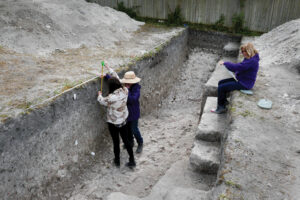
The major discovery was of a cemetery that eventually totalled 53 graves. Since there were no grave goods, it was presumable Christian. Although most of the burials were in simple grave cuts, note that some were outlined by stone slabs, e.g. that in the centre. The late Saxon date was later confirmed by radiocarbon dating.

This suggested that although the present castle was founded by Bishop Alexander "the Magnificent" in the 1130's, there had probably been an earlier Saxon manorial complex on the site.


Image

The discovery of the skeletons provided great publicity for the excavations: the crowds poured in, and during the 4 seasons of 4 - 6 weeks, over 250,000 visitors came to the site. Applications for volunteers greatly exceeded the number of places available, so they had to be limited to periods of not more than 2 weeks at a time. At least 2 guides, drawn form the digging team were on hand each day to explain to visitors what was going on, and because it was possible to undertake finds-processing on-site, visitors were able to observe the whole excavation process .


 This is based on a fuller account in Current Archaeology 156, published in March 1998
 
  • Current Archaeology

     CA 222 Roman Plague Pit

    • Roundhouses: 3000 years of prehistoric design
    • Enamelled vessels from Roman Britain: Celtic art and tourist knick-knacks
    • Inspired by Stonehenge: new exhibition at the Salisbury Museum
    • Village, cemetery and dyke: the archaeology of a northern pipeline
  • World Archaeology

    CWA 30

    • Copan: tunnelling through the myths
    • Deciphering Ancient Maya: cracking that elusive code
    • Sweyhat:  uncovering a Mesopotamian mystery
    • Laos: revealing unchartered territory in the Mekong Basin
 

Opinion

Is the greatest threat to the archaeological profession now:
 

The editors' blog

Calling all independent archaeologists!
MonmouthThe Council for Independent archaeology is holding its annual get-together at Monmouth on Saturday the 30th August, and all archaeologists are invited to attend.
Read more...
 

Visit our timeline of British Archaeology

Norwich was the second largest city in Medieval Britain: why? In recent years a number of major sites covering more than 20 acres in all have been excavated in medieval Norwich, which between them have revolutionised our knowledge of this crucial medieval city. Let us take a look at these excavations in order to throw new light on this question of why medieval Norwich was so big, and so successful.  

Archaeology Festival

Current Archaeology is pleased to once again bring you the best of British archaeology at home and abroad

Smalltalk

No events

Problems logging on?

Click here for help logging on

Fieldwork search

Search for Digs - powered by I Love the Past

Quick Search by area: Scotland | Wales |North West | North East | Yorkshire | West Midlands | East Midlands | Eastern | London | South East | South West | Ireland & IoM
Quick Search by month: 2008: May | June | July | August | September | After September | 2009: Summer

Advanced Search