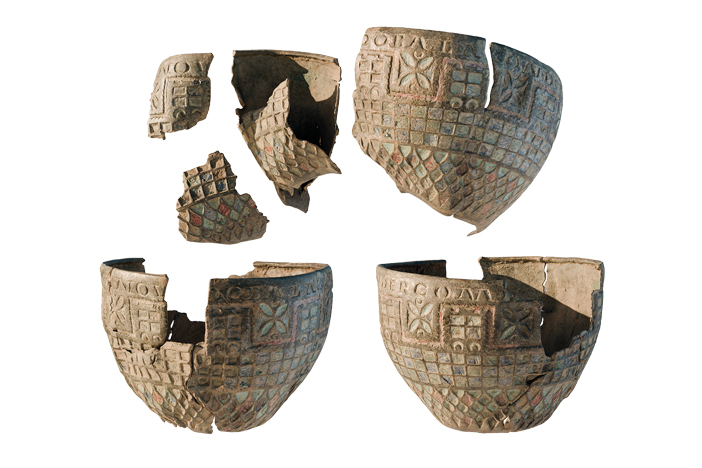
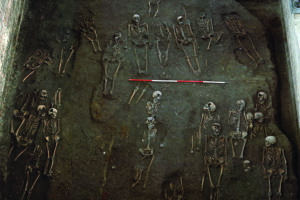
Builders repairing the wall that separates Peterborough cathedral from the town beyond have found a remarkable group of late Saxon grave markers.
Beaker Burials on Thanet Earth
A Bronze Age ‘Beaker' burial skeleton has been uncovered by archaeologists in east Kent. The 4,000 year old remains were found in a small grave at the centre of a double ring-ditch, all that remains of an earth barrow at Monkton, Isle of Thanet. Although 'Beaker' burials are rare in this part of the country, similar [...]
Gold coins of rebel British Emperor uncovered
Two rare gold coins of the rebel Roman emperor Carausius have been discovered on a construction site in the Midlands. Gold coins of Carausius are extremely rare. Only 23 are known, and the last was found as long ago as 1975 in Hampshire.
The chances of surviving the Black Death
Why did some people survive the Black Death, and others succumb? At the time of the plague – which ravaged Europe from 1347 to 1351, carrying off 50 million people, perhaps half the population – various prophylactics were tried, from the killing of birds, cats and rats to the wearing of leather breeches (protecting the [...]
Third Roman Fort discovered in Cornwall
University of Exeter archaeologists have discovered a first century AD Roman fort in south east Cornwall that is only the third Roman fort ever to have been found in the county.
Massive hoard of Bronze Age axes found
A Bronze Age axe hoard has been discovered at a site near Swanage, on the Isle of Purbeck, in south Dorset. Over 300 axe heads were found by metal detectorists, who initially thought they had found an unexploded bomb, so great was the signal from their equipment.
The Ditches : the first Roman villa in the west
In the mid-1980s, a group of archaeology graduates excavated a Roman villa in the Cotswolds but the true significance of the villa is only just being revealed: not only is it the earliest known example of a Roman stone building in the Cotswolds (built AD 75–100), it stands within a late Iron Age enclosure that also contains [...]
Silver of the Iceni
The traditional image is of backward, hostile, bluepainted hordes led by a red-haired fury. Unlike the Celtic sophisticates of the South East, with their wheel-thrown tablewares and imported wines, the Norfolk Iceni were rural primitives. Or were they? Megan Dennis, specialist in Late Iron Age metalwork, pays tribute to the high culture of Boudica’s people.
Ice Age haul from beneath the waves
Hand axes from the Ice Age have been dragged up from the North Sea, just off Great Yarmouth. The 28 hand-axes are over 100,000 years old and were found along with bones and teeth in gravel dredged from the sea floor.
Maritime Salvage
James Morrison takes CA inside the growing danger to maritime archaeology posed by private salvers – is there any 'middle ground'? When uniformed Spanish Civil Guard officers boarded a US-registered commercial archaeology vessel off Gibraltar in July 2007, amid rumours its crew were hiding the location of a £250 million hoard of gold and silver [...]
Irish and Dutch vessels found in Scottish graves
Evidence that some of our prehistoric ancestors travelled considerable distances has come from two graves in Upper Largie, near Kilmartin in Argyll and Bute.
The end of Roman Bath
Bath – Aquae Sulis – was one of the jewels of Romano-British civilisation. What happened to it when the Romans left? Roman specialist James Gerrard has been studying the tantalising evidence for the end of Roman Bath.
Preserving Britain's Glories
When Sir Neil Cossons retired as Chairman of English Heritage in June 2007, his farewell party was held in a building overlooking St Pancras Station. This was a fitting venue given the extent of Neil’s personal involvement in the transformation of William Henry Barlow’s revolutionary train shed – the world’s largest singlespan structure when it [...]
Beetles, Lentils and Anchovies
No, not some new dieting fad - what beetles, lentils and anchovies have in common is their value as indicators of ancient climate change. In a special issue of the journal Fisheries Research (Volume 87, November 2007), an international group of ecologists and historians have drawn upon archaeological material, tax accounts, church registers and monastic account [...]
Coal Mine Tops
Participants in a poll to name Scotland’s most treasured place put Victoria Colliery at the top of the poll. The mine, in Newtongrange, Midlothian, opened in the 1890s and became renowned as one of the first Scottish ‘super-pits’, with a workforce of almost 2,000 at its peak.
Caistor Survey Reveals Iron Age Origins
A recent geophysical survey has revealed the plan of the Roman town at Caistor St Edmund in astonishing detail, including circular features that apparently predate the Roman town and others that could indicate Saxon settlement.
Bath Coin Hoard
Archaeologists working for Cotswold Archaeology have uncovered a rare mid 3rd century Roman coin hoard in Bath. Based on the size of the deposit, this hoard could contain over 1,000 coins and was lifted as a single soil block from the site, where the main pool will be built for the Gainsborough Hotel and Thermal Spa, to be taken away [...]
Rare Roman Shoes
When Wessex archaeologists lifted the lid of a three-tonne stone coffin from Boscombe Down, Wiltshire, last year, they were greeted by the tender sight of a woman cradling a young child in her arms. The sealed environment within the coffin had slowed down the process of decay sufficiently to preserve the remains of the mother [...]
A Truly 'Revolutionary' Neolithic After All?
Most students of prehistory will have wrestled at some stage with the essay question that runs: ‘The Neolithic Revolution was neither Neolithic nor revolutionary: discuss’ – the point being that the lifestyles that characterise the Neolithic do not appear suddenly, but take millennia to develop: wild seed harvesting continues alongside cultivation; hunting alongside animal domestication; and [...]
Return to Ringlemere
Members of Canterbury Archaeological Trust returned to Ringlemere Farm in the summer of 2007, and although nothing was found to compare with the famous Ringlemere Gold Cup (see CA 208) found in 2001 by metal detectorist Cliff Bradshaw, now on display in British Museum, considerable further detail was added to the landscape context for that [...]