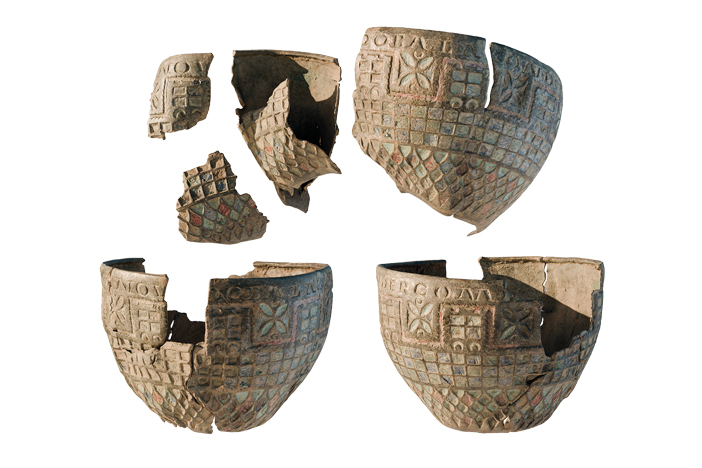
Two very important discoveries have been made at the multi-period site of Higham Ferrers, in Northamptonshire: one a Romano-British shrine complex, and the other an example of the realities – and occasional brutalities – of Middle Saxon regional government. Oxford Archaeology’s Alan Hardy takes up the story. Higham Ferrers lies in what is now an [...]
Metal Detecting & Archaeology
This is a book that reflects the uncomfortable truce that has been reached between pragmatism and ideology within the archaeological community in regard to metal detecting. Papers on metal detector use in Poland and South Africa describe regimes wherein freelance metal detecting is banned; detectors may only be used under licence within a controlled research [...]
Greening the valleys:
the archaeology of industrial Wales Wales was central to the world’s first industrial revolution; the abandoned remains of 200-year-old coal and iron industries litter the valleys. Frank Olding reports on the Green Mines Project, which is conserving and presenting the physical remains in Blaenau Gwent and regenerating this once-plundered landscape. An 18th century ironworks; a wealthy ironmaster’s mansion; poignant [...]
Hill Hall: home of a Tudor intellectual
In 1969, fire raged through this exceptional Elizabethan house. Paul Drury explains what archaeologists were able to rescue from the burnt-out husk. Since 1952, Hill Hall, at Theydon Mount, in Essex, had been a women’s open prison whose unwilling guests included Christine Keeler. To architectural historians, this was indeed a fall from grace for an [...]
Galloping down the centuries: new light on Britain's chalk-cut hill-figures
With the widespread use of optical stimulated luminescence (OSL) for dating soil samples, the mysterious giant hillside carvings of horses and men are finally being placed in an historical context. Paul Newman, author of a comprehensive survey of the subject, considers our current knowledge of these impressive relics, set against the many ways we have [...]
Making a mint: the archaeology of a Late Iron Age industry
There were no credit crunches in the Late Iron Age: highly skilled Celtic mintmasters took painstaking care to ensure money had real, solid, and unchanging value. Mark Landon has studied two huge hauls of coin-making debris from North Hertfordshire and reports on his findings.
Buckles, belts and borders
How soldiers’ fashions reflect political turmoil in Late Roman Britain A Romano-British army in Spain. Anglo-Saxon mercenaries in eastern England. A great tribal confederation spanning south Britain. Stuart Laycock has been finding fresh evidence for the storm and strife at the end of Roman Britain in collections of buckles and belt-fittings.
Metals And Metalworking: A Research Framework For Archaeometallurgy
This is another quietly evangelising publication, priced to ensure a wide circulation and written by the leading experts in their field, part of whose purpose is to alert non metallurgists (NMs) to the sorts of thing that get metallurgists (Ms) excited so that NMs across the archaeological community can help Ms identify sites and material [...]
Hambledon Hill, Dorset, England – Excavation and Survey of a Neolithic Monument Complex
It is astonishing to think that this two-volume report, the definitive account of Roger Mercer’s excavations at Hambledon Hill between 1974 and 1986, has only just been published when the results of those excavations have in fact influenced the thinking of every archaeologist who has ever worked on a Neolithic causewayed enclosure over the last [...]
Who Built Beverley Minster?
Nothing is as good as a question to establish the theme of a book. But in this case the question is not just answered by trawling through historical records to establish which wealthy patrons sought to bribe St Peter by sponsoring the construction of one of England’s finest churches: our authors are just as concerned [...]
Human Remains In Archaeology: A Handbook
This is an excellent book about a subject so fundamental to archaeological field practice that nobody should be let loose on an excavation unless they have read it. Human remains are everywhere, and this book tells us what we need to know about the laws relating to finds of human remains, and how to excavate, [...]
Blood And Mistletoe: The History Of The Druids In Britain
Many archaeologists regard Druids with disdain, as cranks or romantics who claim to have roots deep in the ancient past, but whose practices are largely invented in relatively recent times. This may be so, but archaeologists and Druids share a huge amount of DNA: certainly in the early years of the 18th century, it was [...]
Designs Upon The Land: Elite Landscapes Of The Middle Ages
Tuscany is famous for handsome villas set in elevated positions overlooking formal gardens of clipped box that give way to an increasingly wild landscape of water and woodland and terminating in a borrowed view of distant hills or peaks. The pattern is formulaic and deliberate, and is linked to complex ideas about the relationship between [...]
Roman Mosaics Of Britain Vol 3: South East Britain
Coming to a library near you soon (one hopes, given the investment involved in owning a copy) is the third volume in David Neal and Stephen Cosh’s project to create the first complete corpus of Roman mosaics of Britain.
Europe’s Lost World
Bryony Coles gave the name ‘Doggerland’ to the drowned landscape beneath the North Sea in her 1998 paper in the Proceedings of the Prehistoric Society summing up all that was then known about the archaeology of an area better known for oil rigs and fishing. It is thanks in part to oil exploration and aggregates [...]
Crossing Paths Or Sharing Tracks?
This Society for Post-Medieval Archaeology Monograph derives from a conference held in 2008 at Leicester University with the aim of stopping what the editors describe as the disturbing and potentially harmful fragmentation of post-Medieval archaeology into factions.
Vindolanda
Robin Birley set out to excavate the entirety of the Vindolanda fort and associated civilian settlement on Hadrian’s Wall in 1970, calculating that the task would take him 20 years. Some 36 years on, he now thinks the task will take at least another 100 years of dedicated work.
England’s First Castle
While planning a book on the castles of Herefordshire, Terry Wardle came across references in the Anglo-Saxon Chronicle to a castle built in 1051 by a Norman named Osbern.
Caldecote: The Development And Desertion Of A Hertfordshire Village
The manor house, six labourer’s cottages and a church are all that now survive above ground of one of Hertfordshire’s smallest parishes, but plenty of earthworks survived to hint at a much larger Medieval settlement until 1973, when ploughing began to erode the site rapidly and a five year rescue excavation was set in train.
English Heritage Historical Review Volume 3
Parts of English Heritage could be likened to a private university in that some lucky members of staff (and their advisors and consultants) get to do the kind of primary research that even university academics struggle to find time for these days. Much of this research is used to inform the preservation and presentation of [...]